ACCESSIBILITY
- KEYBOARD NAVIGATION
- DISABLE ANIMATIONS
CONTRAST
- HIGH CONTRAST
- BLACK & WHITE CONTRAST
CONTENT
- INCREASE TEXT SIZE
- DECREASE TEXT SIZE
- MARK TITLES
- MARK LINKS
- UNDERLINE LINKS


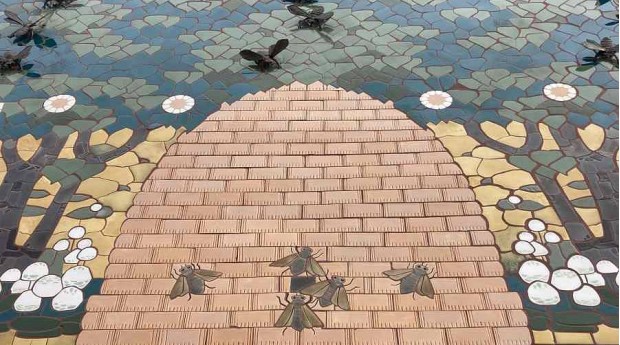
The Bee: Secession Architecture in Radovljica
17.11.2025 10:43

On Gorenjska cesta road in Radovljica, where there are several magnificent villas dating from the start of the 20th century, the most imposing of them all – the so-called Čebelica building (The Bee) – has undergone a thorough renovation and is now back to its full glory.
The Čebelica is one of the most recognisable buildings in Radovljica. It is mainly known among locals for its beautiful façade and characteristic décor above the entrance – a motif of a beehive, after which the building is named. The plans for the building were drawn up by the Slovenian architect Ciril Metod Koch. The Ćebelica was built in 1906 and is regarded as one of Koch’s best architectural works.
Radovljica at the start of the 20th century
At that time, Radovljica was beginning to acquire a new image; the town was beginning to spread towards Lesce. The central axis of the new town quarter, along what is today Gorenjska cesta road, featured a chestnut-tree lined avenue. At the end of the 19th century, first a school, fire station and court were built. It was a time when the artistic trends of the departing historicism and the incoming secession were mixing. Buildings that were constructed in the first decade of the 20th century were the first heralds of a new, modern taste. To this day, Gorenjska cesta road and its near surroundings represent an exceptionally high-quality collection of artistic styles from the first half of the 20th century. In addition to Ciril Metod Koch, Danilo Fürst, Josef Hornek, Josef Seeland and Willy Mohr left their creative legacies here.
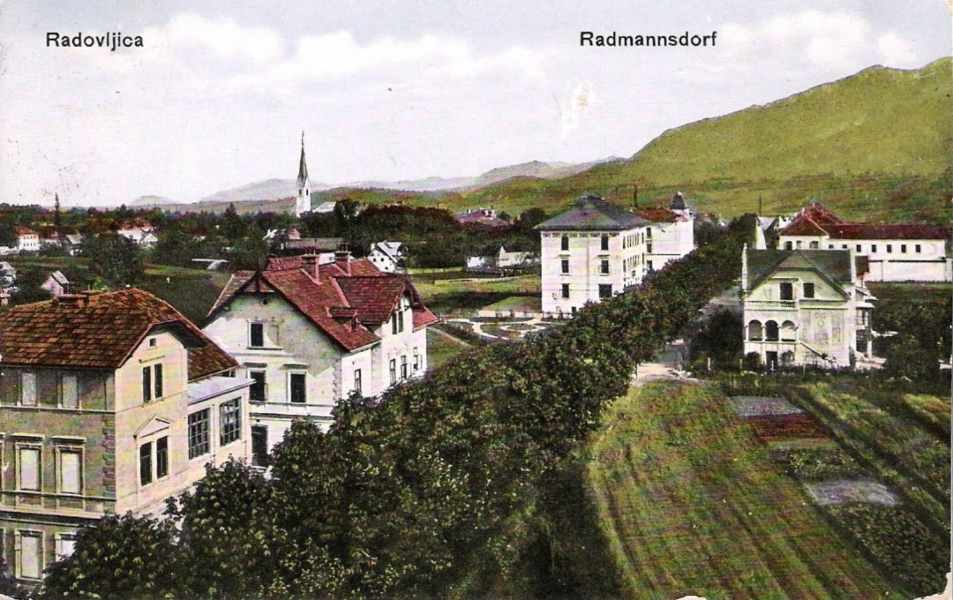
Gorenjska cesta in 1914. In the background, the Čebelica and park area (archive: Zvone Razinger)
The Čebelica from construction to today
Following its construction, the ground floor of the Čebelica building served as a savings bank and a law firm, while the upper floors were apartments. The bee motifs on the façade of the building were unique during the time of its construction. A small park area was landscaped in the immediate surroundings, which has since been changed into a car park. Today the entire building is occupied by the offices of the Radovljica Administrative Unit.
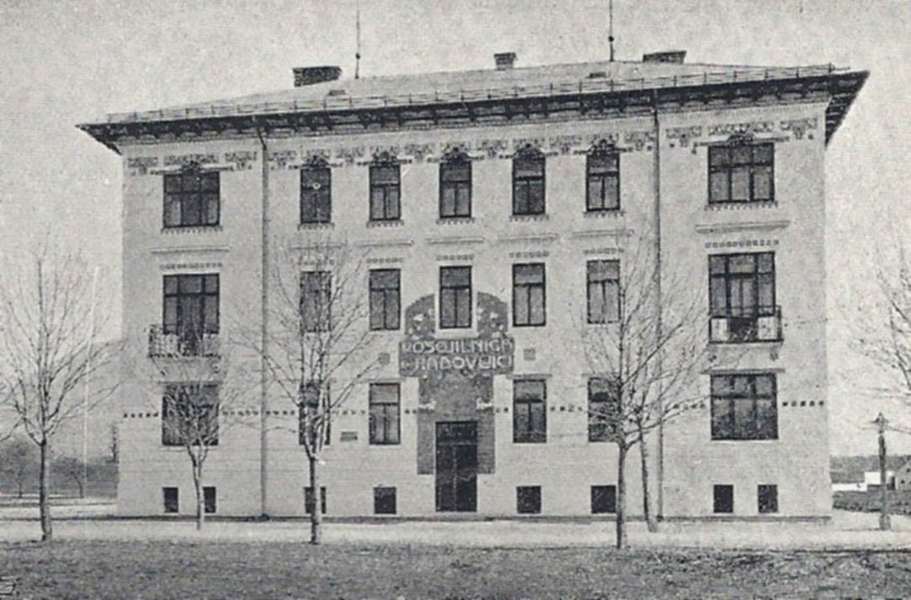
The Čebelica during construction. (archive: dar)
Since its construction, the Čebelica has undergone several renovations and remodelling works, both the façade and the interior. The last significant renovation took place in phases between 1984 and 1987, when the original interior furnishings were replaced by new, industrially produced pieces. The double-leaf opening box windows were abandoned, and some aesthetic accents were redesigned in accordance with the technological capabilities of the time. Attention was paid to the restoration and repair of the façade, which was carried out in ochre with highlighted elements in white. In 1987, the building was declared a cultural and historical monument of local importance.
Due to its exceptional cultural value, the Institute for the Protection of Cultural Heritage, together with the Municipality of Radovljica and the Slovenian Ministry of Public Administration, undertook a comprehensive renovation of the building in 2023. The goal was not just to retouch it, but rather to reconstruct its original state from 1906.
The original double-leaf opening box windows were restored, as well as the original colour scheme of the façade, original architectural accents and decor, including the beehive above the entrance. The renovation was carried out in accordance with conservation guidelines, which enabled the appearance of the Čebelica to be as its architect had imagined it when it was built.
The Čebelica is just one of the architectural gems that testify to Radovljica’s rich history. The town is like an open-air museum, where the works of renowned architects are intertwined, including the Vurnik family, whose work has marked Slovenia’s architectural identity. In addition to Art Nouveau and historical buildings, a visit to the old town centre of Radovljica is ‘a must’. It is adorned with preserved houses from the 16th, 17th and 18th centuries, the remains of the town walls, a preserved town moat and other attractions whose stories enrich the space. Discover them on the Walk Among the Cultural Sights of Radovljica trail.
Related news

See the attractions of Radovljica on one walk
A walk through Radovljica which, in addition to Linhart Square, includes many other attractions and acquaints visitors with some of Radovljica's famous residents from the past. Online map is available to assist with orientation.
Secessionist architecture in Radovljica
Take a walk through Radovljica and look at the secessionist villas built at the start of the 20th century.
28.05.2018 09:48
A record about Ivan Vurnik
Text by Kaja Beton, May 2018
One of Slovenia's most famous architects was born in Radovljica. His most well-known work is the building with the colourful facade on the street Miklošičeva ulica in Ljubljana. On the Tourism Ljubljana website, they call it simply 'Vurnik's House'.
