ACCESSIBILITY
- KEYBOARD NAVIGATION
- DISABLE ANIMATIONS
CONTRAST
- HIGH CONTRAST
- BLACK & WHITE CONTRAST
CONTENT
- INCREASE TEXT SIZE
- DECREASE TEXT SIZE
- MARK TITLES
- MARK LINKS
- UNDERLINE LINKS


Kotel Learning Park

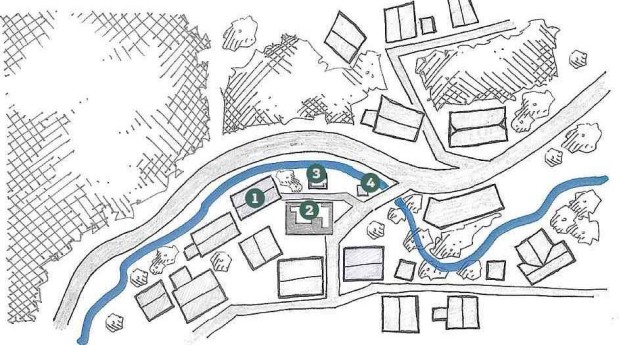
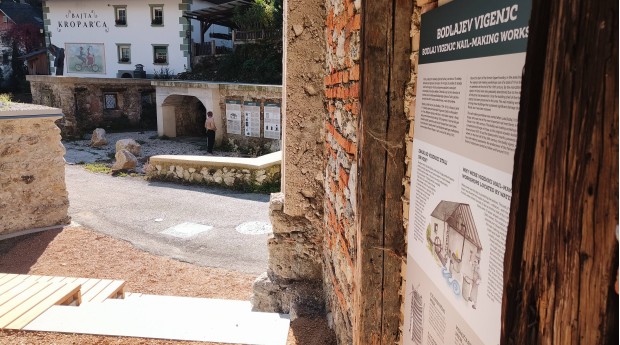
A new Learning Park has been established in the upper part of Kropa, called Kotel. The area of the former Matiček House, the Bodlaj vigenjc nail-making workshop, and the former distillery is equipped with information boards, and from April to November it also features interactive elements for children.
_r.jpg)
_r.jpg)
Kotel, also known as Kotu, is the upper part of Kropa. The slopes of the Jelovica plateau rise up above the area, with steep Zidana skala (Črni vrh, 1,307 metres above sea-level) being the highest point. Beneath it is the Kroparica mountain stream, which after cca. 3 kilometres, at the end of the valley, flows into the Lipnica stream. The area was developed in 2024 with the help of finance from the European Union Recovery and Resilience Fund (NOO). As part of the project, managed by the Radovljica Public Institute for Tourism and Culture, the walls of the former distillery were renovated and protected, and the area was equipped with informative content relating to elements of typical Kropa houses. From spring to late autumn, additional content will be installed in the area, in the form of interactive points for children.
The area, now landscaped as a park, connects three interesting buildings: the Bodlajev vigenjc nail-making workshop, the walls of the former distillery, and the floor plan and remains of the Matiček House, which was demolished at the end of 2023 due to its extremely poor state. In the immediate vicinity, the Čačman shrine is notable, while the Kroparica stream and its diversion into water channels provide a true view of Kropa. Since the area has a wonderful ambience, it is worth seeing when visiting Kropa. The whole has been designed as an experience park, which through information boards and interactive elements (available between April and November) allows visitors to learn, explore and get to know the local heritage, while also offering a pleasant place to stop and rest.
In fact, there used to be slitting mills in Kotel. These were forges where semi-finished products – iron bars – were made with the help of a water hammer. These iron bars were then used to forge nails in nail-making workshops. Even higher up along the Kroparica riverbed, in the area of Dno nad Kropo, there are the remains of an iron smelter from the 14th century (Slovenska peč). It is the oldest monument of its kind in Slovenia.
The following participated in the revitalisation project:
The Ministry of Economy, Tourism and Sport; the Radovljica Public Institute for Tourism and Culture; Radovljica Municipal Museums – Iron Forging Museum Kropa; the Institute for the Protection of Cultural Heritage of Slovenia – Kranj Unit. The project was co-financed by the European Union – Recovery and Resilience Plan.


Related news

Kropa
A pleasant walk through picturesque Kropa – a former centre of iron forging – acquaints visitors with the village’s wealth of cultural heritage. The circular trail leads past the most important sights of interest and reveals magnificent views of the area.
The heritage of iron forging in one place
The history of iron forging particularly comes to life through numerous models which will be set in motion just for you.
